Tuesday, June 11, 2013

Intercede or intervene?


People can cause distress to us in  many ways. As we go through life we find that some people can really push  our buttons, cause us frustration, or elicit anger, disappointment, and sorrow in us. Others are the source of much joy and gratitude. If we are in an administrative capacity and find ourselves having to deal with folk on a daily basis, implement rules and administer correction, we may tend to accumulate the negative feelings more than we have occasion to consciously celebrate the positive ones.

Our decisions in such circumstances may often be a knee jerk reaction expressing those negative feelings welling up within us, or we may intervene to implement our convictions, convinced that it is for the common good.

That often backfires as it stokes the fires of dissension. We must remember that God’s kingdom and His righteousness does not need a trellis to support it. Truth stands by itself without being buttressed by our efforts to reinforce it.
God is still in control, and it is His world.

Rather than intervene, our response can be directed to intercede. Oswald Chambers defines vicarious intercession as "deliberately substituting God's interest in others for our natural sympathy with them.  This practice changes our perspective entirely, and removes our paltry frustrations, as we together come to the throne room, pleading for mercy on us all.  How many of our frustrations reach the presence of the throne room? How many of those people placed in our lives for a reason that is beyond our comprehension actually are upheld by us in prayer?

“For what are men better than sheep or goats

That nourish a blind life within the brain,

If, knowing God, they lift not hands of prayer
        60
Both for themselves and those who call them friend?

For so the whole round earth is every way

Bound by gold chains about the feet of God.”

From “The Passing of Arthur”  by Alfred Lord Tennyson


Monday, June 3, 2013

In His hands


HE HOLDS US IN HIS HANDS


The bible is full of encouragement of how God holds us in His hands. We often fret, fume and worry about the inconsequential. Scattered clouds on our horizon become looming portents of disaster. We see neither the rainbows or the rain. No matter what threatens, God has us in His hands, and we are safe.

HOLD PEOPLE LOOSELY


God holds people in His hands. We often assume unnecessary and unrealistic responsibilities that burden us with unachievable hopes we nourish for them and from them.  Similarly, we over react to opposition and hurt people by our disproportionate responses, because we are holding them too tightly in our minds. God is in control of those that oppose us for the wrong reasons. Opposition for the right reasons are opportunities for us to change.

HOLD WORK LOOSELY


We cling to our identities and professions as if they define us completely. We forget that we are first children of God, and then whatever he has allowed us to become, or do. When our work is threatened, we feel personally threatened, forgetting the one who holds it all in His hands anyway.  If we are asked to lay our work down, we have tremendous difficulty severing the ties that bind us to it, since in many ways, we might have personalized our efforts, forgetting that He is the one who gave us the opportunity to work anyway.

All these injuctions are not so that we can become lazy, or irresponsible, disregard those we work with, or become careless in the dispensation of our duties. These things characterize one end of the spectrum that most attention is paid to.  On the contrary, at the other end of the spectrum, work can stealthily climb on to the throne and displace the place that rightfully belongs to our God. 


Friday, May 17, 2013

Thankfulness

On monday we celebrated Nurses day. Our nurses put up a wonderful skit, provided breakfast to the patients, and put up food stalls where they sold delicious food to raise money for the poor patients fund. A great time was had by all.

They presented me with a card they had made. I will treasure it.

I think back on the distance we have come. Our nurses today will equal the best in tertiary institutions. They work sincerely, empathetically and very efficiently. They are the true ministers of compassion and healing. Of course, the newer ones still have to learn. And of course there are some who find it difficult to learn. But as a whole they have come a long way. I am proud of them.


Sunday, May 12, 2013

Come, take, learn


COME TAKE LEARN


Mathew 11: 28-29

These words are very comforting to the laborer toiling without any hope of reprieve or respite. Jesus “Come unto me, all ye that labour and are heavy laden, and I will give you rest. Take my yoke, and learn of me.”

The verbs here are come, take, and learn.

We often place great emphasis and draw much comfort from the call to come. The comfort that Jesus is perpetually there for us to come to at any time is a solace and succor.  We think of times of retreat, and meditation, when a holy glow pervades the room we are in, and even may place an imaginary wreath on our perspiring foreheads. However, the call is not to a wilderness retreat, but a call given in the thick of manual work. In the daily humdrum of our lives, the call to come, eclipses the others, which remain forgotten injunctions. We rest our tools in the glow of comfort, forgetting the compulsions that follow.

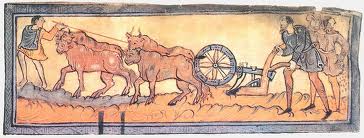
Take  my yoke. A yoke is always used to hitch two oxen. Jesus never asks us to bear the yoke alone. We confuse crosses with our yoke, and the daily burden of our lives are transformed by us into a cross, which we think we grudgingly have to bear. We are to remember, that it is His yoke, not ours. Often in arenas of work, we delude ourselves that the work is ours, and then possess it. The yoke is never ours. It is always His. We are asked only to come alongside. He bears it with us. This removes from us the weight and the burden of it. It is His work anyway.

Learn of me. How do we learn from a Master? We accompany Him as He works. We observe, we follow, we pay attention. We can never learn of the master from out of under the yoke. When students shadow a teacher they admire and respect, they find themselves unconsciously mimicking his methods and his mannerisms. Reading a book can never teach them the lessons they learn from him.  Sir William Osler, a nineteenth century physician had said, “He who studies medicine without books sails an uncharted sea, but he who studies medicine without patients does not go to sea at all.”.

Jesus asks us to learn of him. For, He says, He is meek and gentle. Only when we feel the muscles strain in the heat of the day on hard ground, can we learn about meekness and gentleness. These lessons are rarely inherited. They are learn in the furrows of labour alongside the Master.

We have to come to him. How can we come but in brokenness, and poverty. We can come only when He draws. From then on, He may not take away the labour and the furrow, but He asks us to accompany Him and learn from within the furrow.

Monday, May 6, 2013

Building

http://utmost.org/building-for-eternity/

"All that we build is going to be inspected by God. Is God going to detect in His searching fire that we have built on the foundation of Jesus some enterprise of our own? These are days of tremendous enterprises, days when we are trying to work for God, and therein is the snare. Profoundly speaking, we can never work for God. Jesus takes us over for His enterprises, His building schemes entirely, and no soul has any right to claim where he shall be put."

A common entrapment for workers is the work itself. 

It is so easy to get attached to projects,buildings, and efforts, and call it MY effort, MY work, My job. It is much like the ring around the neck of Frodo Baggins in the "Lord of the Rings". Enchantment, and entrapment welded into a circle. Letting go is unthinkable, and its sticky allure is self destructive. There is the trap. 

Holding work in an open hand is our only hope of exit, the charm that breaks that enchanted weld. 

The key words are it is His work, and we are servants. The only way to survive is to stay as servants. 


Tuesday, April 23, 2013

Fellow labourers


We were visited recently by Dr. Regi Thomas, and Dr. Rajan, ENT surgeons from CMC Vellore. They visited with their families and conducted an ENT camp here in Manali. Two hundred patients were seen in three days and surgeries performed. It was very refreshing to spend time with them.  Earlier we were visited by Dr. Chuck Thompson, Luke Walters and Lonnie, from the United States. Dr. Chuck is a prominent interventional cardiologist there.

We all need encouragement wherever we may work. This can come from patients, from families, from the turn of circumstances. However, the right hand of fellowship is when two like minded people come together and spend some time together. There is something special when hearts motivated by service to our Master come together, and a commonality emerges as shared experiences that need not be elucidated join paths for a brief while. It leaves each person encouraged, and as paths diverge again to continue the journey, each heart leaves a little warmer.

I was very encouraged by the support that is in the hearts of senior people like these towards work in small areas like that we work in. They are at the apex of academia and practice. They have achieved standards of practice that are internationally recognised and are at the cutting edge of advancement. Yet their hearts reach out to the remote regions and workers who are far removed. This is the love of the Lord, reaching out to us.

It is a proud realisation that we have partners like this, and that we can all mutually continue to strive and encourage each other in our respective journeys.


Saturday, April 6, 2013

LOOKING BACK, LOOKING FORWARD


The road to Ladakh is a formidable one. Tremendous gorges plunging into ravines,  and immense sandy plains confront the traveller, stretching the mindscape by its vast hostility and daunting solitude.  This photograph taken in the  rear view mirror of my motorbike is self expressive, from the time we took  a medical camp into the Zanskar valley.  I think it holds a powerful life lesson.

All of us have stories from our journeys. Our life lessons have not all been pleasant tales of green pastures and flowing waters. Yet, on our respective roads, we all do get the opportunity to look back, and then continue to look forward.

Why is looking back important? Even the people of Israel, on their Exodus were constantly asked to “Remember”.  We tend to forget. What does our rear view mirror show us?

For all of us, we can remember times and seasons of struggle, yet support and direction through those battles. Of strength, provision, and friends who came alongside us.  The recognition of the hand of God, watching, leading and guiding. When He has led us thus far, we can draw inspiration for the formidable challenges ahead. Our struggles shape and mould us, develop our muscle to be able to navigate the twists and turns of the boulder strewn horizon more gracefully than we did in the past. And we have the opportunity to draw not just on brute strength, but also the wisdom that was gleaned from pinnacles of the past.

One trekker, who has trekked the Rohtang pass in his youth,  walked over it again in his fifties. He said, that this time, he had one thing going for him. He had less strength and stamina, but he had the wisdom  and experience that his earlier summits had left him with.

We are all called out. We have been led so far. We can look backward with grateful thanks. And that strengthens us to look forward to the future with hope.

  • ·      Let us look back and count the times we have been led, guided and helped.
  • ·      Where we are now is a testimony to where we have come from and what we have come out of.
  • ·      Let us recognize these historicial events in our lives with gratefulness.
  • ·      Let this knowledge equip us for the road ahead, secure in the knowledge that the God of our yesterdays holds our tomorrows.